
We Analyzed 100 LATAM Dev Agencies. They're Posting the Wrong Content.
The Latin American software services industry has decided that the way to win business in 2026 is to publish more. We analyzed 8,223 Instagram and LinkedIn posts from 100 LATAM agencies, classified each one by topic, and normalized engagement against follower counts. The category that agencies post the most of is the category with the worst engagement rate in the dataset.
That is the finding. The rest of this post is what it means.
The inversion
Thought-leadership posts account for 24 percent of total volume and have an engagement rate of 0.0089, the lowest of any category we measured. Behind-the-scenes content sits at 21 percent of volume with an engagement rate of 0.0352, the highest. Most agencies are putting their biggest production effort behind their weakest performing format, and doing it in plain sight.
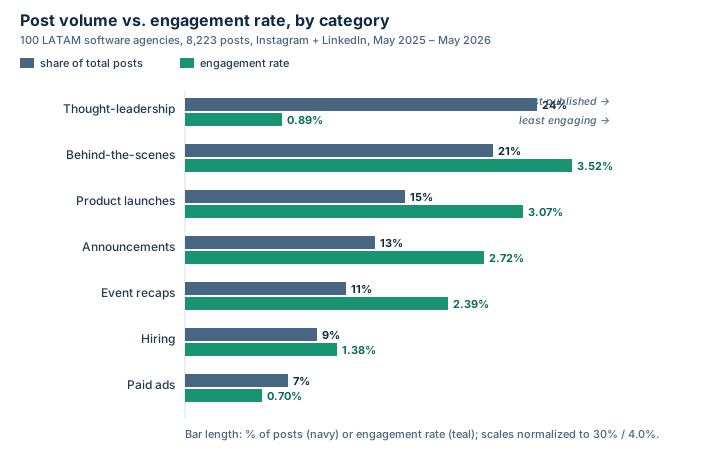
Why this happens is unmysterious. A generic post about why AI matters in 2026 is safe. It cannot embarrass anyone, it looks credible to a board that audits the marketing function once a quarter, and it requires no logistics. A behind-the-scenes post needs a real photo of a real human doing a real piece of work. That is harder to produce, easier to do badly, and more revealing. The audience rewards the harder one by a factor of roughly four.
The pattern extends past the two extremes. Product launches sit at 0.0307 ER, announcements at 0.0272, event recaps at 0.0239. All three outperform thought-leadership by two to four times. Even hiring posts (0.0138) beat it. The only category that performs worse than thought-leadership is paid ads, which is a different problem.
Format matters separately
Reels deliver 0.028 ER against 0.0182 for static and carousel posts on Instagram, a roughly 1.5x advantage. Most agencies post more static than Reels because static is cheaper to make. The math says they are saving money on the wrong production cost.
Inside the carousel category the breakdown is sharper. Engagement by slide count is bimodal:
- 2-slide carousels: 0.0383 ER
- 9-slide carousels: 0.0383 ER
- 5- to 7-slide carousels: around 0.015 ER (the trough)
- Single image: 0.013 ER (the floor)
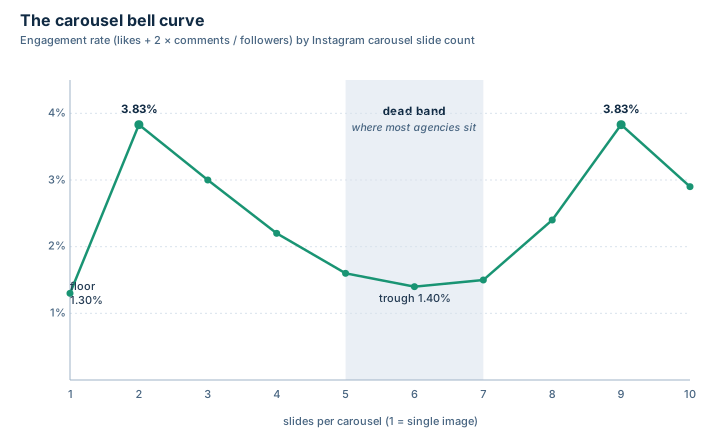
Either go very short, two slides, a punchy contrast, or go very long, nine slides, a complete narrative. The 5-to-7 slide zone is the worst place to be. It is also where most agencies sit, because a carousel that feels balanced to a producer (not too long, not too short) is exactly the carousel that readers neither skim nor commit to. The format feels safe and dies quietly.
The cadence trap
Of the 100 agencies sampled, two publish more than twice per week consistently. The other 98 range from “once every other week” to “barely active.” Most sit at one post per week, and many fall below that.
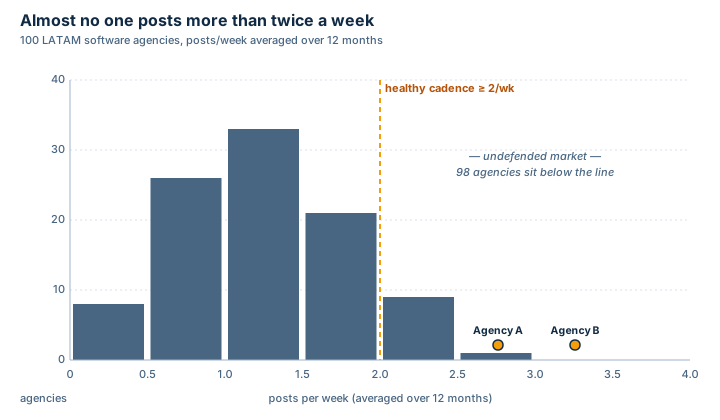
This makes cadence itself a useful signal. An agency that maintains a two-to-three-posts-per-week rhythm across twelve months is not just performing for the feed algorithm. It is demonstrating the operational discipline a buyer wants on the delivery side. Sporadic posting and inconsistent delivery share a root cause more often than not.
It also means the market is undefended. Three high-quality posts a week puts a new agency in the top three percent of LATAM agency posting frequency. The bar is lower than the industry assumes. Volume that ships into the dead band, generic thought-leadership at low cadence, is worse than silence. Volume that ships into the high-ER formats at consistent cadence is rare enough to constitute a strategy by itself.
Vertical concentration is a buyer’s tool
When we tagged each post with the industry vertical it referenced, five verticals accounted for 56 percent of all mentions: fintech (20%), healthcare (13%), education (10%), energy (7%), gaming (6%). The remaining 44 percent splits across roughly twenty verticals at low single-digit shares.
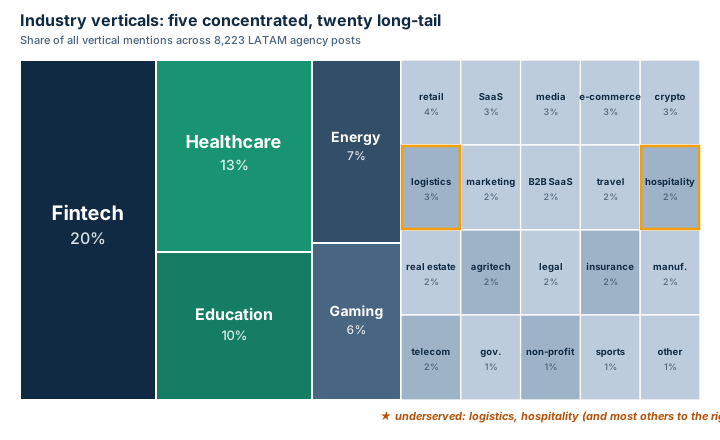
If you are buying nearshore development for a logistics, hospitality, real estate, government, professional services, or industrial B2B platform, the agency content you see is overwhelmingly about other industries. The case studies are about banks. The frameworks are about telemedicine. The hiring posts are for fintech platform engineers.
This is uncomfortable for agencies in the contested verticals, because everyone is competing for the same buyer pool. It is useful for buyers in the uncontested ones, because the few agencies with genuine depth in those industries are easier to identify against a fintech-shaped background. When evaluating an agency, the verticals it discusses on social over six months are a more reliable signal than the list on its homepage. The homepage list is aspirational. The social feed is what the agency has actually worked on enough to have opinions about.
What to do if you are shortlisting
A handful of checks you can run before a first call. None of them require access to the agency, only their public feed.
Look at the format mix first. A feed dominated by single images and 5-to-7 slide carousels means the agency is publishing in the dead band. They are doing content as obligation, not as something connected to acquiring buyers. The agencies shipping Reels, 2-slide contrasts, and 9-slide deep-dives are paying attention to the data the rest of the industry is ignoring.
Then look at cadence over twelve months, not three weeks. Scroll back a full year. Were the gaps consistent or sporadic? Did they go quiet for two months in Q2? Posting discipline correlates with delivery discipline. It is not a perfect predictor, but it is a free one.
Then look for the maintenance gap. Most agency content is built around the launch moment. Almost nothing covers the work at month six and twelve, the retraining, the boring support that decides whether the project compounds or rots. If the social feed has zero posts about that phase, ask them in the first call: who runs this in month twelve, what does the team look like, and how is it scoped in the contract.
Then check vertical specificity. If the pitch deck lists ten industries served but the social feed has only ever discussed three, assume the other seven are aspirational. The verticals that show up repeatedly are the ones the agency has real opinions on.
Finally, the soft signal: original research. Has the agency ever published primary analysis, real data, real benchmarks, a framework they derived from a body of work? Or only re-statements of well-known points? An agency that has done one piece of primary research has demonstrated the ability to look at its own market with critical distance. That same instinct tends to show up on the delivery side, in how they scope projects, push back on assumptions, and refuse the wrong work.
Why we ran this
This analysis was a side product of trying to make sense of a complaint we kept hearing from founders and CTOs: there are dozens of agencies pitching them and they cannot tell any of them apart. The data confirms the complaint. Most agencies are publishing the same kind of content, at the same cadence, into the same five verticals. From the buyer’s seat, indistinguishable.
We are CAMF Solutions. We help businesses get up to speed with AI, and stay there through long-lasting, dynamic partnership. Our model is built around the maintenance gap, the work that most pitch decks skip. We orchestrate a small, vetted specialist team for each engagement, ship the first version, and stay for the long-tail work that decides whether the system compounds or rots.
If you are evaluating an AI or custom-software partner this quarter and any of this resonated, send us the workflow you most want to automate and the platform it runs on. We will send back a one-page sketch of how we would approach it. No sales follow-up.
The shorter version of everything above: the way an agency posts is a fast and free signal for how it operates. Before you sign a nearshore contract this quarter, scroll back twelve months on the social feed. The data is in plain sight.
Methodology: 100 LATAM software agencies sampled from a 1,912-company dataset, filtered to ≥30 employees and an IT-services focus. 8,223 posts ingested across Instagram (4,400) and LinkedIn (3,823) from May 2025 through May 2026. Posts classified into a closed taxonomy using Claude Haiku 4.5. Engagement rate calculated as (likes + 2 × comments) divided by latest follower count per company.